This lesson explains what the Law Society of Ontario's generative-AI guidance and the 2026 Legal Aid Ontario Lawyer Self-Report requirement mean in day-to-day practice. It is general information about regulatory guidance, not legal or professional-responsibility advice, and reflects Ontario requirements as of August 2026 — confirm your current obligations directly with the Law Society of Ontario.

This lesson assumes you already know roughly what a generative AI tool is doing when it drafts or answers something. If you're new to how these models work at all — and specifically why they hallucinate, go stale, and sound confident when they're wrong — start with Module 1: AI Fundamentals for Legal Practice first; the duties below will make more sense with that grounding in place.
No new rules — three existing duties, applied
In its April 2024 white paper on generative AI, the LSO didn't create an AI-specific rulebook. It confirmed that three existing professional-conduct rules already cover it, and spelled out what each one requires when a tool is involved.
Competence (Rule 3.1-2). You have to understand what the tool can and can't do before you rely on it, and independently verify anything it produces before it reaches a client or a filing.
Scenario — an associate asks a generative AI tool to summarize case law for a factum. Competence means reading the actual cases before the summary goes in the document, not trusting the tool's citations on faith — hallucinated citations are one of the risks the LSO names directly, and this isn't hypothetical: at least three reported Canadian court decisions in 2025 alone sanctioned lawyers for filing AI-hallucinated case citations, a track record the competence rule exists specifically to prevent.
Update, September 1, 2026. That risk isn't slowing down. In June 2026, Ontario's Law Society Tribunal ordered a suspended lawyer to pay $31,150 in costs after his own filings relied on AI-fabricated case citations he never checked — reported at the time as the largest AI-citation costs award by any Canadian court or tribunal (Mazaheri v. Law Society of Ontario, 2026 ONLSTH 112). Months earlier, that same regulator's 2026 budget had put part of a licensee fee increase behind CanLII's generative-AI legal research project. See the deeper look at both stories together for what the pairing means for firms evaluating AI tools.
Confidentiality (Rule 3.3-1). Before client information goes into any AI system, you need to know how that system collects, stores, and uses the input.
Scenario — pasting a client's settlement details into a general-purpose chatbot to get a faster first draft is a confidentiality decision, not just a productivity one — know the tool's data-retention and training policy before you paste.
Supervision (Rule 6.1-1). If a junior lawyer, paralegal, or staff member uses AI on a file, supervising that work is your obligation, the same as supervising their non-AI work.
Scenario — a paralegal drafts a client letter with AI assistance; the responsible lawyer's review still has to happen before it goes out, not after.
Update, September 15, 2026. That supervision scenario only covers a paralegal supervised by a lawyer — it undersells the fuller picture. The LSO's April 2024 white paper is written for “licensees,” the statutory term covering both lawyer and paralegal licence classes, and pairs every duty above with its Paralegal Rules of Conduct equivalent in a side-by-side table: Competence (RPC 3.1-2 / PRC 3.01(1)), Confidentiality (RPC 3.3-1 / PRC 3.03(1)), Supervision (RPC 6.1-1 / PRC 8.01(3)). An independent paralegal — one licensed to appear at Small Claims Court, the Landlord and Tenant Board, or on summary Provincial Offences matters without a supervising lawyer — carries these duties directly, not only as supervised staff. See our full breakdown of whether LSO's AI guidance applies to paralegals for where a real gap does show up: Legal Aid Ontario's 2026 self-report attestation is worded for roster lawyers only, with no paralegal equivalent found in LAO's published materials.
Free download — competence, confidentiality, and supervision are one lesson of five. Get the free Lawyer AI Academy guide, all five modules compiled into one PDF grounded in this same LSO guidance.
When client consent comes into the picture
The LSO's guidance doesn't require telling every client you used AI on their file, as a blanket rule. But informed consent may be required in specific circumstances — chiefly when client information would be entered into a system that retains it or could use it to train future models. The guidance points to three practical questions when deciding whether disclosure is warranted: would the AI's involvement be made public regardless; would the client reasonably expect you, personally, to have prepared the material; and would client personal or proprietary information be entered into the system at all. If the answer to that last one is yes and the tool's data handling isn't fully understood, that's the moment to pause and get consent — not after.
Update, September 8, 2026. The clearest real-world case of this three-question test is a live client meeting recorded by an AI notetaker. Recording it is legal on its own — Canada's one-party consent rule under the Criminal Code lets a lawyer who is a party to the conversation consent to recording it alone. But a live conversation can't be anonymized before a third-party tool processes it the way a document can, which collapses this guidance's two-step test to one step: get informed consent before the tool runs. See the full breakdown of AI notetakers in client meetings for how the two rules interact.

The 2026 shift: it's now a checkbox on your annual filing
Guidance is one thing; an attestation is another. Starting with the 2026 filing cycle, Legal Aid Ontario requires every roster lawyer to confirm, on the annual Lawyer Self-Report, that they have read and are complying with the LSO's generative-AI guidance.
Since January 2026, Legal Aid Ontario requires every roster lawyer to confirm annually, on the Lawyer Self-Report, that they have read and comply with the Law Society of Ontario's generative-AI guidance.Legal Aid Ontario, December 2025 in-brief
That turns AI literacy from a personal-interest topic into a standing compliance item with a specific date attached. If you take Legal Aid work, "I haven't looked into this yet" stopped being a neutral answer in January.
Update, September 2, 2026. The scale of this shift keeps growing. A March 2026 global report from LEAP Legal Software, surveying 700 legal professionals across Canada, Australia, New Zealand, the U.S., the U.K., and Ireland, found Canadian respondents reported the highest share of any country surveyed — 23% — saying AI had saved their firm "a significant amount of time," with 75% reporting at least a moderate time saving. For any Ontario lawyer still treating this guidance as optional reading, that's the backdrop: AI use in Canadian practice isn't a minority behaviour anymore, which makes the competence, confidentiality, and supervision duties above apply to more of your daily practice than they did a year ago.
A four-question vendor checklist
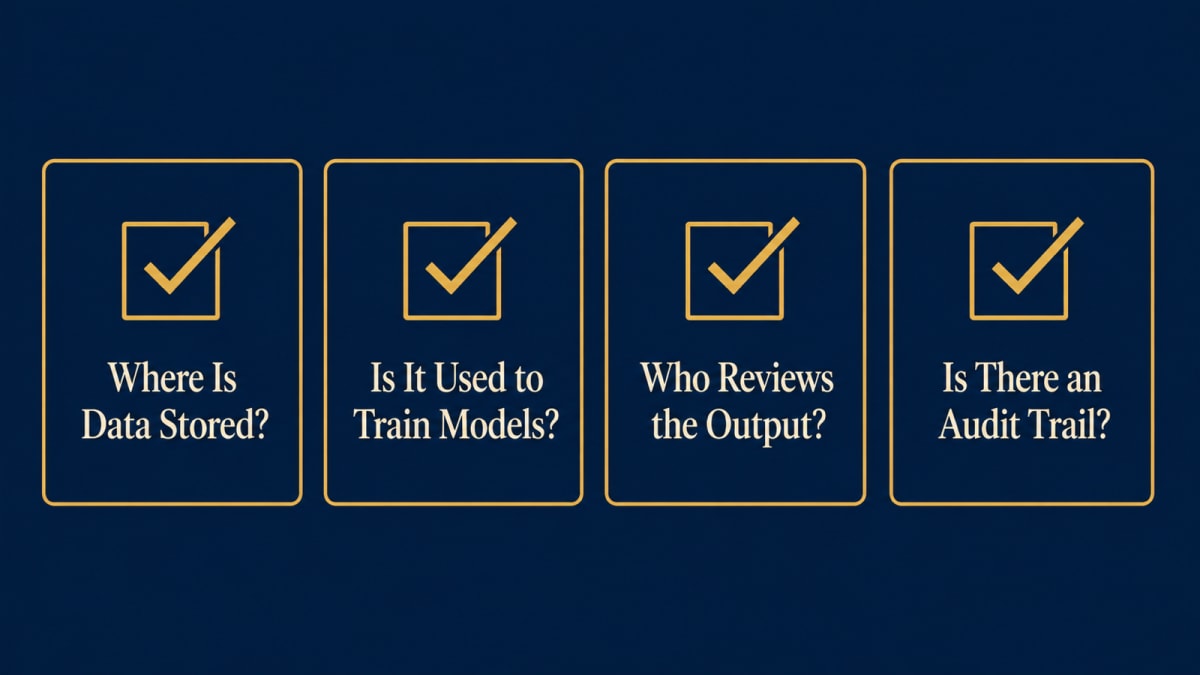
Whatever tool you're evaluating — a general chatbot, a legal-specific assistant, or a full practice-management platform's built-in AI — the LSO's guidance reduces to four questions worth asking before client information touches it.
- Is client input used to train the model? If yes, that's a confidentiality problem before it's anything else.
- How long is the data retained, and by whom? "Deleted automatically" and "retained indefinitely for product improvement" are different products, whatever the pricing page says.
- Where is the data processed? Some jurisdictions carry compelled-disclosure exposure that Canadian-hosted alternatives don't.
- What can the tool do without your approval? Drafting and suggesting is a different risk profile than a tool that can send, file, or transfer without a human in the loop.
Module 3 of this Academy walks through how to put these four questions to a vendor in a real evaluation call — if you'd rather not wait for it to publish on its own, join the newsletter and it lands in your inbox the day it's live.
What this means for choosing a tool
These questions aren't abstract for us either — they're the same ones we'd want a firm to ask about DROZlegal. On data: client data is stored in Canada (AWS ca-central-1), and AI processing runs through Anthropic's commercial API, which doesn't use inputs or outputs to train models and deletes them automatically within roughly 30 days — not "zero data retention," which is a different, unclaimed arrangement. On the fourth question — what a tool can do without approval — DROZlegal's agents can prepare drafts, route work, and queue actions, but six categories of action (trust money, court filing, settlement, commencing litigation, engagement approval, outbound client email) are permanently gated to a human, by design, not by setting. Trust money in particular carries its own separate, detailed compliance regime under LSO By-Law 9, distinct from the generative-AI guidance covered here — see our complete guide to By-Law 9 trust accounting for Ontario law firms for that side of practice regulation. For a longer look at how that compares to an AI add-on approach, see Clio vs DROZlegal: Feature by Feature. This guidance covers Ontario's professional-conduct rules specifically — for the wider federal picture (AI-specific legislation, privacy law, and how provincial guidance like this fits together), see our guide to AI laws in Canada.
Frequently asked questions
Can I use ChatGPT for client work? Yes — the LSO doesn't prohibit general-purpose AI tools. You still have to independently verify anything it produces, understand its data handling before client information goes in, and supervise any AI-assisted work the same way you'd supervise a person's.
Do I have to tell clients I used AI on their file? Not automatically, as a blanket rule. Disclosure and informed consent become relevant when client information would be entered into a system that retains or trains on it, or when the client would reasonably expect the work to be prepared by you personally — the three-question test above is the practical way to decide.
What records should I keep? The guidance doesn't prescribe a specific log format, but given the January 2026 Lawyer Self-Report attestation, it's worth being able to show, if asked, which tools you use for client work, what you know about their data handling, and how you verify their output before relying on it.
Read more from the Academy: Lawyer AI Academy hub, or continue to Module 3: Evaluating AI Vendors.
Not ready to subscribe? Join the DROZlegal waitlist instead.