
What Law Society of Ontario By-Law 9 actually requires
Every Ontario lawyer or paralegal who holds client funds answers to By-Law 9. The core obligations are precise, not stylistic guidance:
| Requirement | What the rule says |
|---|---|
| Segregation | Client funds held in a separate trust account, never mixed with the firm's operating funds |
| Reconciliation | Three-way comparison — trust bank balance, trust ledger balance, sum of individual client listings — completed monthly, within 25 days of month-end, even in months with no trust activity |
| Client ledgers | A current, individual ledger for every client whose funds the firm holds |
| Balance floor | No single client's balance may ever go negative |
| Retention | Trust receipt and disbursement records kept for 10 years plus the current year |
These rules aren't administrative overhead layered on top of practicing law — they exist because trust money belongs to the client, not the firm, at every point until it's properly disbursed. Ontario lawyers are personally accountable for every trust movement under By-Law 9, which is precisely why the software handling that money matters as much as the bookkeeping habits around it.
Sourced directly from the Law Society of Ontario's By-Law 9 text (segregation s.7(1); reconciliation and 25-day deadline s.18(8) and s.22(2); client ledgers s.18(3) and s.22(1); no-negative-balance rule s.9(3); 10-year-plus-current retention s.23(2)), accessed 2026-08-20.
Why passing a routine spot audit isn't proof your trust accounting is safe
The Law Society runs periodic spot checks on every licensee's books — commonly reported as roughly every three to five years, often including a firm's first year of operation. It's tempting to treat a clean spot check as confirmation that a firm's trust accounting is sound. A 2022 case shows why that's the wrong conclusion to draw.
A boutique Toronto firm, Cartel & Bui LLP, passed a routine LSO financial spot check in the summer of 2022 — even though the firm's own bank statements showed nearly $140,000 in irregular trust-account withdrawals that month, including payments to American Express and a child-care centre. One of the firm's two named partners, lawyer Singa Bui, was later found — through an LSO disciplinary hearing presenting more than 2,000 pages of uncontested evidence — to have misappropriated more than $12 million from 13 clients' trust funds, mostly real-estate buyers and sellers, over several years; she was disbarred in December 2025. Her law partner, Nicholas Cartel, faces separate LSO disciplinary charges and one criminal fraud charge, both of which he disputes and neither of which has yet been heard. Source: CBC News' original investigation and its December 2025 reporting on Bui's disbarment hearing, corroborated via canadianfraudnews.com, September 26, 2025.
"They presume honesty… They're really trying to catch people who can't do accounting and are making bona fide mistakes… It does not catch fraud, and it happens all the time for millions and millions of dollars," David Debenham, an Ottawa lawyer and forensic accountant, told reporters covering the case. That's the distinction worth sitting with: a spot check is built to catch bona fide bookkeeping mistakes — a missed reconciliation, a mis-posted entry — not a pattern of deliberate withdrawals someone is actively trying to hide.
The more common way firms fail By-Law 9 — no fraud required
Deliberate fraud like the case above is rare. The far more common way firms run into By-Law 9 trouble is mundane, and compliance-guide sources consistently point to the same three failure modes:
- Commingling client and operating funds — even briefly, even unintentionally, when a firm's bookkeeping doesn't cleanly separate the two.
- Late or skipped monthly reconciliation — missing the 25-day window, or skipping a reconciliation in a month that looked quiet.
- Incomplete individual client ledgers — a firm-wide trust balance that's technically accurate while individual client records fall out of date.
None of these require intent to become a real professional-conduct problem. They're also exactly the failure modes that manual, spreadsheet-based trust bookkeeping is most prone to — a formula that breaks silently, a row that doesn't get updated, a reconciliation that gets pushed to "next week" and never quite happens.
What compliant trust-accounting software needs to do structurally
"Has a reconciliation report" is a low bar. The more useful question is whether the software makes the common failure modes above structurally harder to fall into, not just easier to fix after the fact.
DROZlegal's trust module is one working example of what that looks like in practice: client balances are protected two ways at once — an application-level check that refuses any entry that would push a client negative, and a database constraint underneath it that enforces the same rule even if the application layer were ever bypassed. The three-way reconciliation itself is pure arithmetic, not an AI estimate — the system compares the bank balance, the ledger balance, and the sum of individual client listings, and flags any variance instead of asking a lawyer to rebuild that comparison by hand every month.
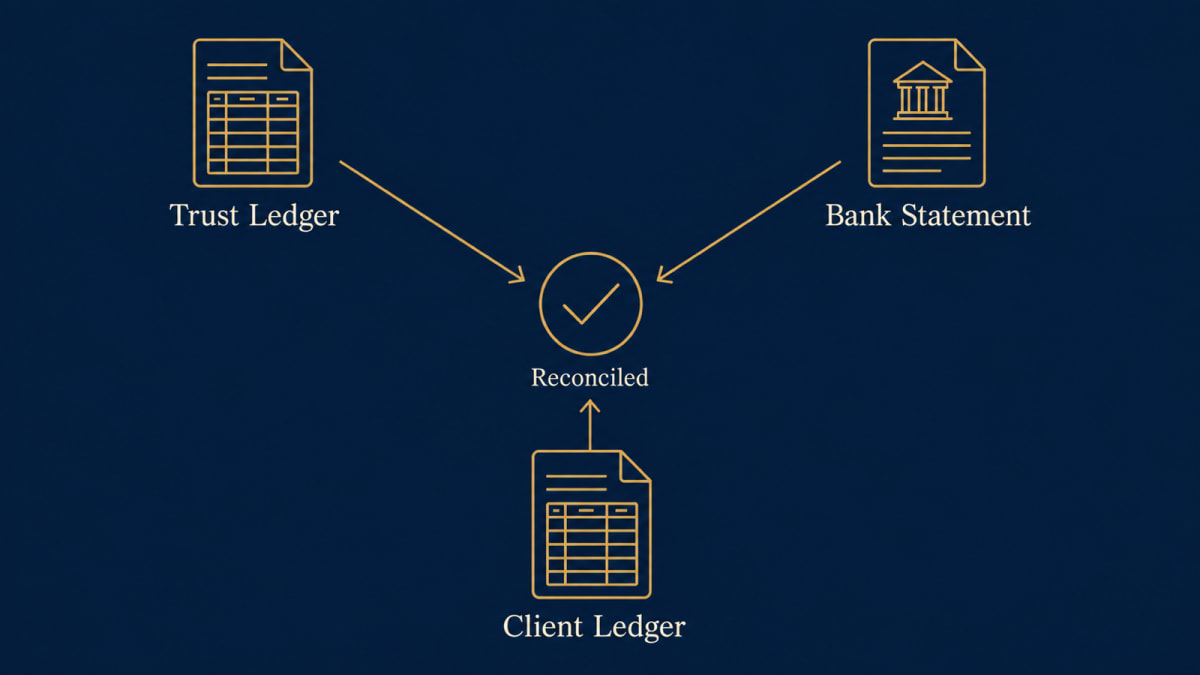
The part that matters most, given the example above: moving trust money is one of six actions permanently hard-gated to a human at DROZlegal, alongside filing with a court, settling, commencing litigation, approving an engagement, and sending email to the outside world. Software can prepare the reconciliation and raise an alert the moment a shortfall risk appears — it should never be the thing that executes a transfer. (See our full trust-accounting comparison against CosmoLex for how this plays out feature-by-feature.) Academy Module 5, Why AI Should Never Move Trust Money, goes deeper on why this design principle — not just this specific By-Law 9 requirement — should apply to any AI vendor a firm evaluates.
If your firm is still reconciling trust accounts in a spreadsheet, that's exactly the gap the DROZlegal waitlist conversation is for — seeing what a structurally-enforced reconciliation looks like instead of a formula that can silently break.
Update, August 27, 2026: Two capabilities shipped since this guide's last edit, both grounded directly in By-Law 9's own text. DROZlegal now drafts Form 9A (the electronic trust transfer requisition required under By-Law 9 s.12) and Form 9C (the closing funds electronic transfer form required under s.13) straight from the trust ledger — both strictly read-only DRAFT outputs a lawyer reviews, verifies against the current LSO form wording, and files themselves, and both handle reversed entries correctly by design: Form 9A refuses to draft against a reversed entry at all, and Form 9C excludes reversed amounts from its total and refuses to combine withdrawals across more than one trust account. Separately, a By-Law 9-aligned cash-retainer guardrail now enforces the $7,500 aggregate cash-per-client-matter limit automatically at the point a retainer or invoice payment would cross it, rather than surfacing the problem only at reconciliation time. Source: DROZlegal's own capability inventory. (Trust and general billing are separate systems here by design — for the invoice, fee, and accounts-receivable side of the practice, see our guide to AI billing and accounts receivable automation for Ontario law firms.)
Five things to have ready before an LSO spot audit
- The current month's three-way reconciliation, completed within the 25-day window, not still in progress.
- Up-to-date individual client trust ledgers for every client whose funds the firm currently holds.
- Bank statements that match ledger entries line by line — any unexplained gap is exactly what a reviewer will ask about first.
- Ten years plus the current year of retrievable trust records, not archived somewhere nobody can quickly pull them from.
- A documented explanation for any unusual withdrawal pattern — the case above shows what happens when nobody internally is asking that question before a regulator does.
Update, September 28, 2026: for a side-by-side look at which trust-accounting platforms actually structurally enforce requirements like these — including a genuine finding that PCLaw is being sunset by its own vendor — see our 2026 trust accounting software comparison for Ontario law firms.

Frequently asked questions
What does LSO By-Law 9 require for trust accounting? Client funds in a segregated trust account, a monthly three-way reconciliation (bank balance, ledger balance, sum of client listings) completed within 25 days of month-end, a current ledger per client, no client balance ever negative, and trust records retained for 10 years plus the current year.
What should three-way trust reconciliation software actually do? Independently compare the trust bank balance, the trust ledger balance, and the sum of every client's individual listing, and flag any variance — not just record transactions and leave the comparison to a spreadsheet.
How often does the Law Society of Ontario audit trust accounts, and does a passed audit mean the books are safe? Spot checks are commonly reported as happening roughly every three to five years, often including a firm's first year, though the Law Society doesn't publish a fixed public schedule. A passed check isn't proof against fraud — spot audits are built to catch bookkeeping mistakes, and the case above shows a real instance of one missing an active, multi-year embezzlement.
Can trust-accounting software move client funds automatically? No compliant platform should, and none reviewed on this site does. Ontario lawyers are personally accountable for every trust movement under By-Law 9; moving trust money should always stay a human-only action, never something automation completes unsupervised.
Not ready to subscribe? Join the DROZlegal waitlist instead.