Disclosure: this comparison is written and published by DROZlegal. Claims about Clio come from Clio's public materials and independent 2026 coverage, and are marked as such; verify current features and pricing at clio.com. Claims about DROZlegal describe shipped functionality. We include an honest section on where Clio is ahead.
The snapshot
Choose Clio if you want the extensive third-party integration ecosystem Clio's public materials describe as legal tech's largest, built-in payment processing, and the reassurance of the market incumbent — especially if your staff already knows it or your firm depends on niche integrations.
Choose DROZlegal if your bottleneck is the work itself — intake, engagement letters, document drafting, deadlines, trust bookkeeping — and you want software that executes those steps and queues them for your approval, with Canadian data residency and Law Society-shaped guardrails as the default, and all-inclusive flat pricing rather than a per-seat plan with paid add-ons.
AI: assistant beside the software vs agents inside it
This is the deepest difference, so it goes first. Clio's AI, Clio Duo, is a separately priced add-on reported to work only within Clio Manage.
Independent 2026 coverage describes its strengths as drafting suggestions, matter summaries, deadline extraction, and time-entry help — and its limitation the same way: the AI assists; it sits beside the software rather than running the work.
See our full Clio Duo alternative breakdown for what it drafts today, including its October 2025 rebrand to Manage AI.
Update, August 26, 2026: Duo/Manage AI isn't Clio's only AI product. Clio also sells a separate AI research-and-drafting workspace, Clio Work (from $199 per user monthly, launched October 2025), into which Clio folded its Docket court-monitoring tool on August 18, 2026 — marketed as giving access to “more than 1 billion” U.S. federal and state court filings (Clio, Aug. 18, 2026 press release). Per Clio's own materials that specific database is confined to “supported U.S. jurisdictions” — a separate matter from Clio Work's Canadian availability, which launched July 23, 2026 on Jurisage's Compass database (470,000+ cases across 43 Canadian courts, acquired the month before). See our full Clio Work alternative breakdown for the sourced detail on what each database actually covers.
Update, September 8, 2026: Add a fourth or fifth Clio AI brand to that count, depending how you're tallying: Clio Draft, the document-automation tool Clio acquired as Lawyaw in 2021 and rebranded in 2024, launched in Canada on April 1, 2026 with template libraries for Ontario estate planning, probate, and family law, plus British Columbia estate planning and family law (Clio's own launch press release). It's a narrower tool than either Duo or Work — a template-filling add-on to Clio Manage, not a research workspace or a practice-automation platform, and per independent review it doesn't manage, version, or search documents once they're created. See our full Clio Draft alternative breakdown for the sourced detail on what it does and doesn't do, and where DROZlegal's own drafting and Ontario court-form registry fit by comparison.
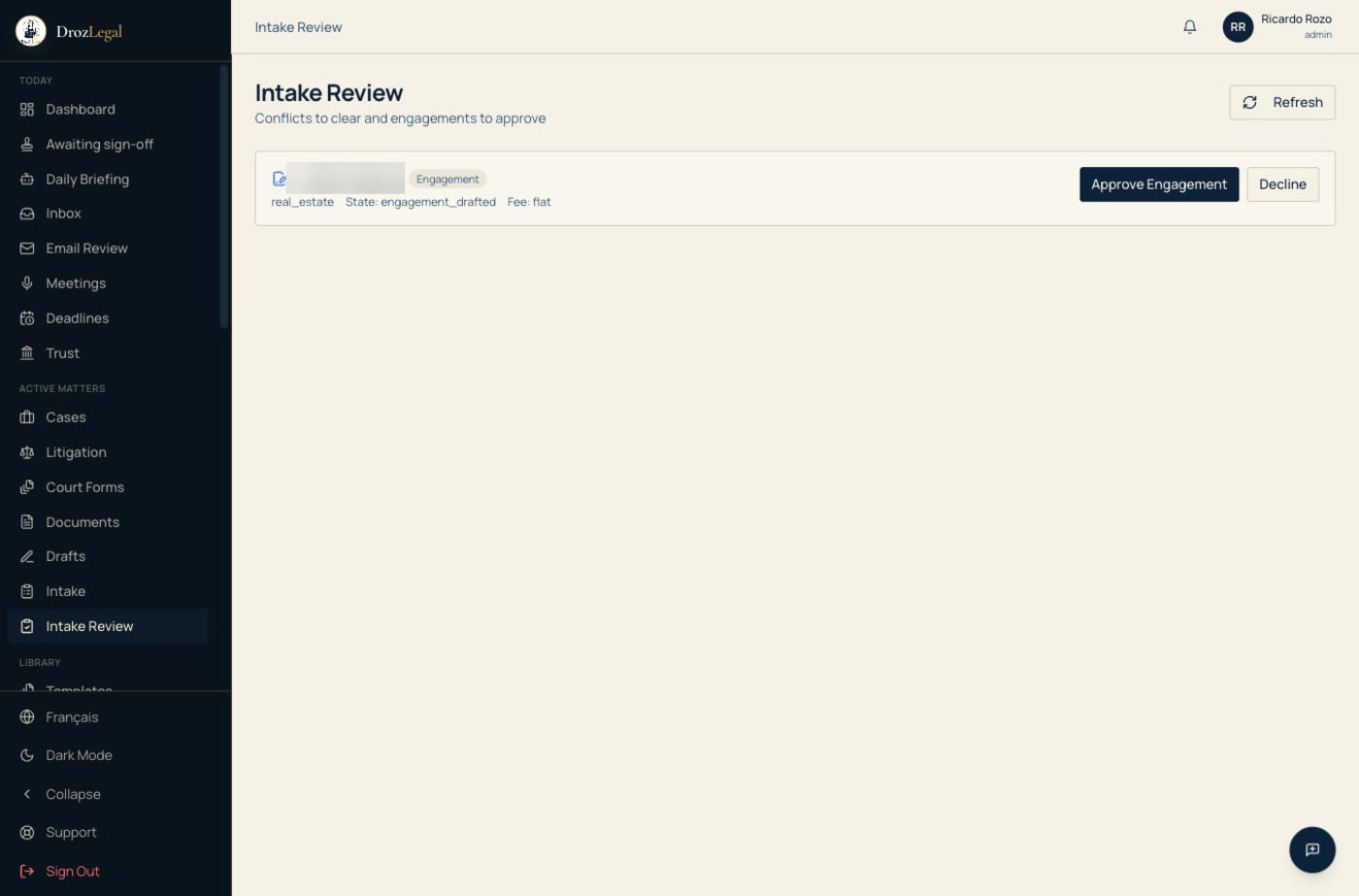
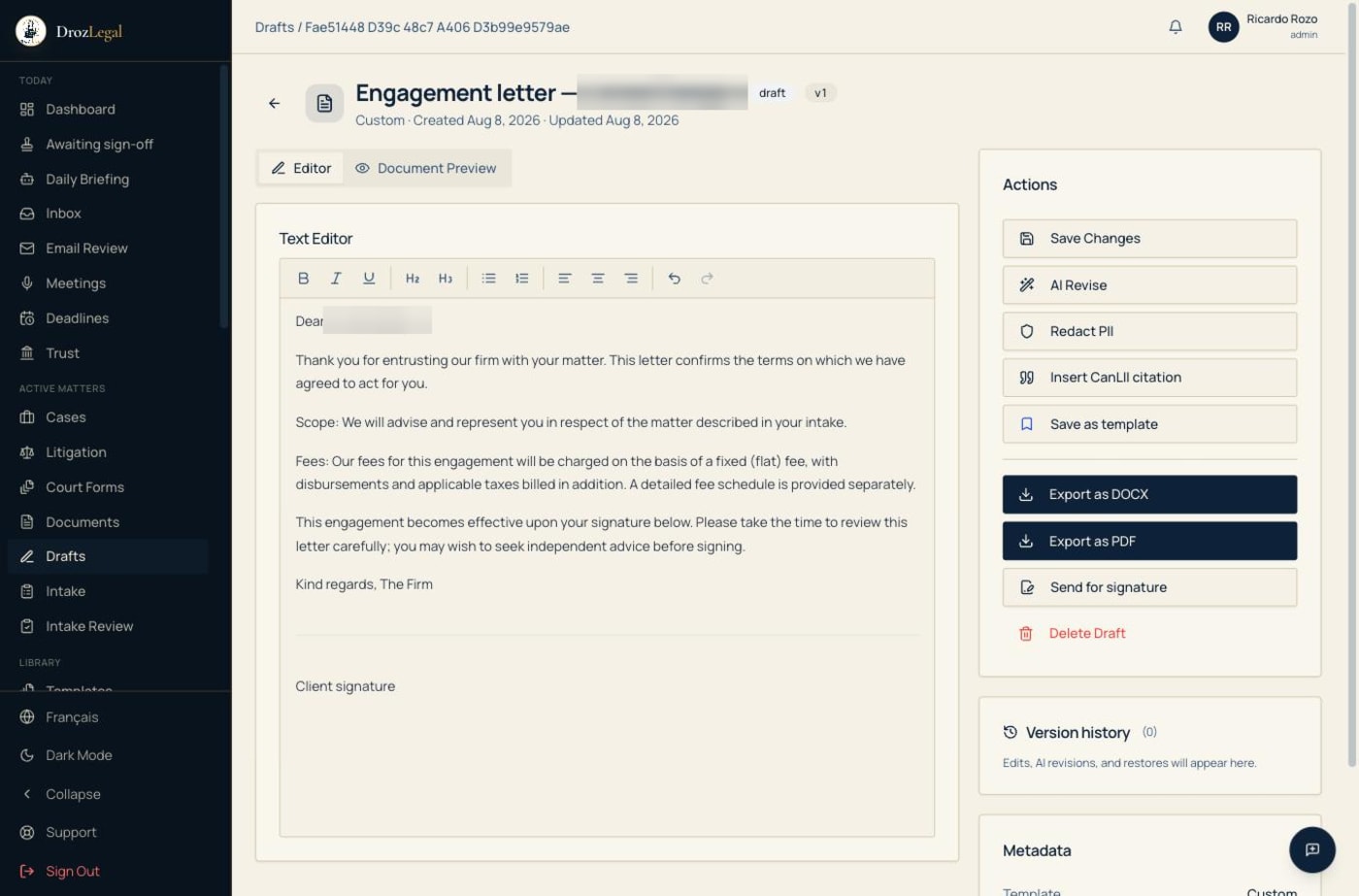
DROZlegal's agents are the platform, not an add-on. When an intake form arrives, the system screens it, routes it to the right lawyer, and produces a drafted engagement letter waiting at an approval gate — in live firm use, about two minutes from submission to draft.
The same pattern runs document drafting, deadline computation, and a morning briefing of what needs a decision.
Crucially, the autonomy has a ceiling by design: six actions are permanently hard-gated to humans — moving trust money, filing with a court, settling, commencing litigation, approving an engagement, and sending email to the outside world. The AI can prepare all of them; it can complete none of them.
(For the broader argument — why that gate matters for every small Canadian firm evaluating AI, not just DROZlegal — see AI practice automation for small Canadian firms.)
Trust accounting
Both platforms support trust accounting; the design philosophies differ.
DROZlegal's trust module is built Ontario-first around LSO expectations: three-way reconciliation support, negative-balance protection enforced with database-level checks alongside application guards, and the hard ceiling above — the software computes, reconciles, and flags, but a trust transfer can never execute without a human.
If your law society audit posture is the deciding criterion, that structural refusal is the feature to compare when you evaluate any platform's trust workflow, Clio's included.
Automation depth
The design philosophies diverge here: independent coverage of Clio Duo describes assistance — suggestions and summaries the user acts on — while DROZlegal treats a matter as a pipeline: event arrives (an email, a form, a date, a document) → the system advances the file → a lawyer approves at the gate.
Deadline math is deterministic code, not an AI guess. The practical difference: the platform is built so the lawyer reviews finished output instead of producing it.
Practice-area depth (Canadian)
DROZlegal ships Ontario-specific machinery natively: court-form generation for litigation (DOCX and court-ready PDF), a real-estate stack with client-identification and verification gating (LSO By-Law 7.1), e-signature flows and Statement of Adjustments reconciliation, OBCA/CBCA corporate minute-book templates, and criminal-practice tooling including disclosure handling built around the Jordan timelines.
Clio counters with breadth: it serves practice areas across two countries with a configure-it-yourself model and add-ons from its marketplace.
Integrations and payments — Clio wins here
Clio's public materials describe its app directory as the largest in legal tech, and per those materials Clio Payments gives firms built-in payment processing designed for legal billing.
DROZlegal has no third-party marketplace; its accounting story is a two-way QuickBooks Online sync (invoices, bills, trust-safe mappings; write-back enabled per firm) rather than native payment rails.
If your firm's stack depends on many point integrations, Clio is ahead and this section should weigh heavily in your decision.
Data residency and AI data handling
Both vendors offer Canadian data hosting — this is not a differentiator to overclaim. DROZlegal's specifics: client data is stored in AWS Canada (ca-central-1), encrypted in transit and at rest.
On AI processing, DROZlegal uses Anthropic's commercial API, which does not use client inputs or outputs to train models and deletes them automatically within approximately 30 days — a precise, documented posture (not "zero data retention," which is a separate negotiated arrangement we do not have and do not claim).
Ask any vendor, including us and Clio, the same three questions: is client data used for training, how long is it retained, and where is it processed? More on our security posture is on the security page.
Pricing model
Clio prices per user across tiered plans (USD-denominated in public pricing guides — confirm your region's billing currency at clio.com/pricing), with AI (Duo), growth tools, and e-signature available as separately priced additions.
Independent coverage notes the add-ons are where costs stack, with Duo reported around $49–59 monthly.
Clio Duo, Clio's AI add-on, is reported in independent 2026 coverage at roughly $49–59 monthly on top of the base per-user plan. Source: independent 2026 coverage of Clio pricing.
DROZlegal prices flat and all-inclusive: every one of the platform's 22 modules is included at every tier, with no per-module upsell — and a bilingual English/French interface is included, not an add-on.
Where Clio is ahead — the honest list
- Nearly two decades of market presence and the most recognized brand in legal practice management.
- The integration marketplace.
- Native payments.
- A large support and consultant ecosystem.
- Brand familiarity among hires.
DROZlegal is a newer platform working with founding partner firms in Ontario — you will be an early customer, with the leverage and the risk that implies. We would rather tell you that here than have you discover it on a sales call.
Frequently asked questions
Can DROZlegal replace Clio for a small Ontario firm? For matter and document management, intake, drafting, deadlines, trust accounting, and QuickBooks-based billing — plus the automation described above — yes; that is its exact target profile. For a firm dependent on many third-party Clio integrations or native payment processing, run the integration inventory first; the gaps section above is the honest checklist.
Does DROZlegal's AI act without lawyer approval? Within a matter it can prepare and advance work, but the six hard-ceiling actions — trust money, court filing, settlement, commencing litigation, engagement approval, outbound email — always require a human. That boundary is structural, not a setting you can toggle off.
Is my data used to train AI models? No. Inputs and outputs processed through DROZlegal's AI are not used for model training and are automatically deleted by the AI provider within approximately 30 days. More on our security posture is on the security page.
Evaluating more options? Start with our broader guide: Best Clio Alternatives for Canadian Law Firms (2026).
Not ready to subscribe? Join the DROZlegal waitlist instead.