
Disclosure: DROZlegal publishes this guide and builds a practice-automation product for Canadian law firms. The adoption and regulatory statistics below are sourced directly from LEAP Legal Software's, Best Lawyers in Canada's, and Canadian Lawyer magazine's own 2026 published research, not ours.
What "AI for lawyers" actually covers in 2026
"AI for lawyers" gets used as one phrase for three different things, and mixing them up is where most bad buying decisions start.
A general-purpose chat assistant like ChatGPT or Copilot answers whatever you type, with no legal training and no memory of your firm's files between sessions. A legal-specific AI tool is built and tuned for one legal task — research, drafting, or contract review. A practice-automation platform is a different shape of thing entirely: a named job that carries a task through several steps on its own and stops at a defined point for a lawyer to approve.
If you need the plain-English basics before any of the rest of this — what generative AI actually is, mechanically, and where it breaks — start with our plain-English guide to generative AI for lawyers. This piece assumes that grounding and goes wider: the current Canadian numbers, the rules that already apply, how to evaluate a vendor, and where automation is (and isn't) doing real work at Canadian firms right now.
The 2026 adoption numbers — and the gap inside them
Two separate 2026 surveys tell a consistent story: Canadian lawyers are moving fast on AI, and the firms around them are moving slower.
LEAP Legal Software's Profitability in Law: Global Report 2026 surveyed 700 legal professionals across Canada, Australia, New Zealand, the US, the UK, and Ireland, published March 24, 2026. Canadian respondents reported the highest rate of significant AI time-savings of any country in the study: 23% said AI saved their firm a significant amount of time, and 75% said it saved a moderate to significant amount. 43% said legal-specific AI tools were having the biggest impact on their firm's profitability and efficiency.
Best Lawyers' 2025 Mid-Year Canadian Legal Market Survey (204 responses, mostly from firms with 100+ lawyers recognized in the 20th edition of Best Lawyers in Canada, released September 4, 2025) found that 89% of firms were either piloting AI for research and document review or had fully integrated it, and zero respondents said their firm wasn't pursuing AI in some form. Only 8% remained purely exploratory. The same survey found 42% of respondents naming AI integration and legal-technology regulation as the single most significant issue facing the Canadian legal profession right now.
23% of Canadian legal professionals say AI has saved their firm a significant amount of time — the highest share of any country surveyed. — LEAP Legal Software, Profitability in Law: Global Report 2026 (March 24, 2026)
That 89% figure describes large, established firms. The picture looks different away from the top of the market — see our breakdown of AI practice automation at small Canadian firms for where solo and small-firm adoption actually sits, and our full Canadian adoption landscape piece for how these figures compare with individual, day-to-day usage across firm sizes.
Read the two surveys together and a pattern holds across firm size: lawyers report real, measurable value from AI — faster turnaround, fewer billable hours lost to first drafts, better-supported research — while governance (a written policy, a disclosure practice, a defined approval gate) consistently lags behind the tools themselves. That gap, not the technology, is where most of the actual risk to a firm sits.
Three shapes of AI a Canadian firm actually buys
Once you're past "should we use AI," the real decision is which of three shapes you're buying — because the answer to "what still needs a lawyer" is different for each one.
| Shape | What it is | What still needs a lawyer |
|---|---|---|
| General-purpose assistant | A chat tool not built for legal work — ChatGPT, Copilot, Gemini. | Everything: accuracy, confidentiality, and judgment all rest on the person typing the prompt. |
| Legal-specific AI tool | Research, drafting, or review software trained or tuned for one legal task — Lexis+ AI, CoCounsel, Spellbook, Harvey. | Checking every citation and clause before it goes into a document a client or court will see. |
| Practice-automation platform | A system that runs a defined, multi-step workflow end-to-end and stops at approval gates — an intake-to-engagement chain, for example. | Approving the output at each gate — engagement, trust money, filing, and the other hard ceilings below. |
For a job-by-job comparison of specific products in each category, see our roundup of the best AI tools for lawyers in 2026 — it's organized by task, not by brand, which matters more once you know which shape you actually need.
Most firms don't pick one shape and stop — they stack them. A lawyer might use a general assistant for a quick research question, a legal-specific tool for drafting a factum, and a practice-automation workflow for the parts of intake and billing that don't need judgment at all. The mistake isn't using more than one; it's assuming the safeguards that come with one shape automatically apply to another. A chat tool's "don't paste confidential facts in" rule doesn't tell you anything about whether a workflow platform's approval gates are real.

The rules that apply before you've even chosen a tool
Even before you pick a tool, three layers of rules already apply to how you can use it — and Canada effectively added a fourth in 2026.
Your law society. The Law Society of Ontario's generative-AI guidance doesn't create new duties; it applies the existing competence, confidentiality, and supervision rules to a new kind of tool. See our plain-language walkthrough of LSO's guidance for what that means matter by matter. Every Canadian province has its own law society with its own version of the same core duties — our guide to AI laws across Canada covers how the (currently stalled) federal picture and provincial guidance fit together.
Privacy law. PIPEDA already governs how client data moves through any AI tool, and Quebec's Law 25 adds its own consent and disclosure requirements on top. Our AI legal software buyer's framework walks through what PIPEDA and Law 25 actually require before you sign a vendor contract.
The courts, now too. Canadian Lawyer magazine surveyed all 51 Canadian courts about their generative-AI policies for a report published June 10, 2026, and counted 21 of 51 with some form of documented guidance for lawyers and litigants — including the BC Court of Appeal, the Quebec Court of Appeal, the Superior Court of Quebec, and the Yukon Court of Appeal, cited as the most developed. That's an obligation layered on top of your law society's rules, not a substitute for them — check the specific court's rules before you file anything AI touched.
Stay ahead of the next compliance change. One email when a rule, a deadline, or a product update actually affects how you work — nothing else.
What to check before your firm signs with any vendor
Once the rules are clear, the next filter is the vendor in front of you. Not every tool marketed to lawyers is built the way it should be, and the questions that separate a defensible choice from a liability are specific, not general.
Does it train on your client data? Ask for this in writing, not in a sales deck. The Anthropic commercial API, for example, does not use customer inputs or outputs to train its models, and those inputs and outputs are auto-deleted within roughly 30 days — a specific, checkable claim. "Zero retention" is a different, separately negotiated arrangement almost no vendor actually has; treat that exact phrase as a flag to dig deeper, not a fact to accept.
Where is the data processed, physically? Data residency in a Canadian region is a checkable technical fact, not a marketing adjective — see our security and data-handling page for what "Canadian data residency" should actually mean when a vendor claims it.
Does it finish the task, or hand you the next draft? A chat answer you still have to copy into a letter isn't automation — it's a faster typewriter, and it doesn't reduce the number of places an error can hide.
What can it do without anyone clicking approve? This is the question most vendor demos skip past. Our full vendor-safety checklist goes deeper on all four of these, with the follow-up questions to ask when a sales answer sounds too clean.
Is the vendor stable, or a likely acquisition target? 2026 has been a heavy year for legal-tech M&A — Legora's acquisition of the Canadian platform Walter AI is the clearest recent example of what changes (and what doesn't) when your AI vendor gets bought. See what an AI-vendor acquisition actually changes for the questions worth asking before you sign, not just after.
Is a Big Tech platform entering this category, and does it say anything about Canada? Google Cloud launched a purpose-built Gemini Enterprise for Legal on August 25, 2026 with four named U.S. law firm customers — and, per our review of the launch materials, no mention of Canada or Canadian data residency anywhere in them. See what that specific launch does and doesn't say about Canada for the four questions worth asking any vendor before you assume “private to your organization” means processed inside Canada.
Where AI is actually earning its keep, function by function
Inside a Canadian firm, the tools that are genuinely working in 2026 cluster around a handful of jobs — not "everything," despite what some vendor pitches imply.
Intake. A public intake form gets triaged, checked against the firm's existing client list for conflicts, and turned into a provisional matter automatically. See our guide to AI legal intake software for what a finished version of this looks like versus a chatbot bolted onto a contact form.
Drafting, review, and research. Clause-level contract risk flags, document comparison, due-diligence scans, and research chat over a firm's own document library are now common in legal-specific tools — the category our job-by-job tools guide breaks down by task.
Trust accounting — deliberately narrow. This is the one place the industry should stay conservative. On DROZlegal's platform, for instance, the trust-accounting layer is compute-only: it runs three-way reconciliation and books the ledger, but no AI model ever initiates a movement of client funds. That's not a limitation to route around — it's the correct design for money that belongs to someone else.
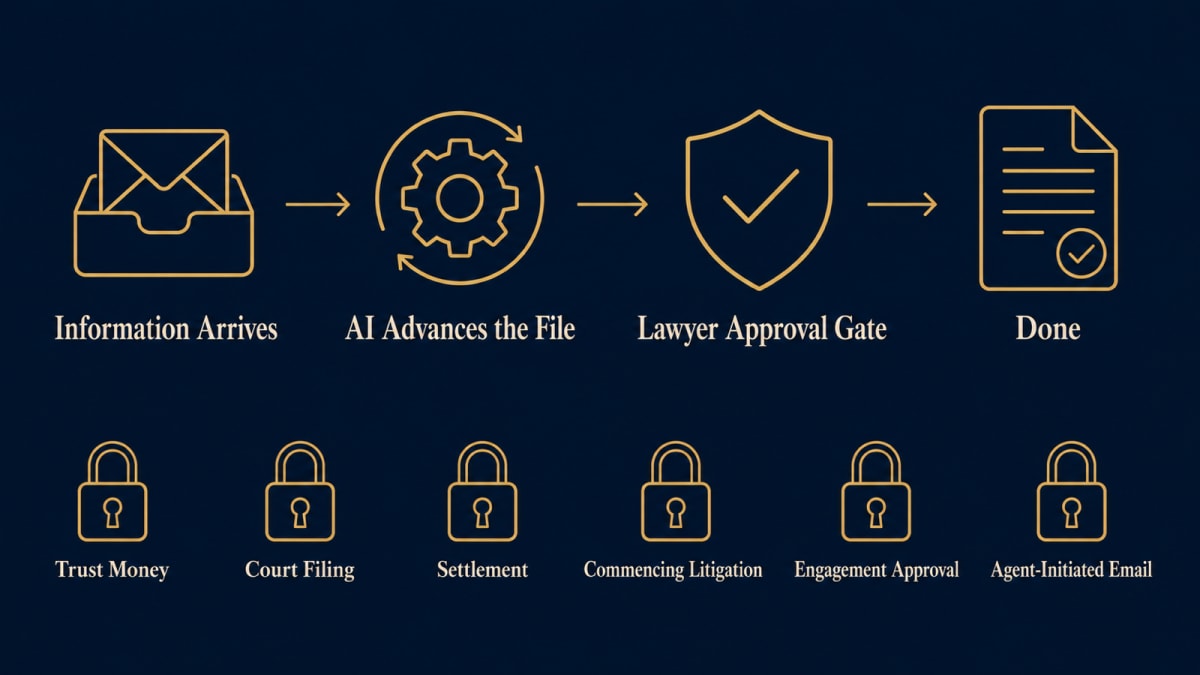
A concrete example of the "finishes the task" difference. DROZlegal's intake-to-engagement chain takes a public intake-form submission, triages it, checks it against the firm's existing client list for conflicts, opens a provisional matter, and drafts an engagement letter automatically — then stops at a lawyer-approval queue; the letter is never sent or the engagement finalized without a lawyer's sign-off. See how DROZlegal's agents are scoped for the full list of what runs unattended and what always waits for a human.
What no automation can do without a lawyer in Canada
Every legitimate practice-automation platform — DROZlegal included — draws the same six lines, because they aren't really product decisions. They're the actions a regulator, a client, or a court expects a licensed human to take personally, every time:
- Trust money moves only when a lawyer moves it. No agent authorizes a trust transfer or issues a trust cheque on its own.
- Court filings are made by a lawyer. AI can draft and assemble a document; a lawyer reviews it, signs it, and files it.
- Settlements are finalized by a lawyer. An AI-drafted offer summary is not client authority to settle.
- Litigation is commenced by a lawyer. Nothing starts a claim or an application on a workflow's own initiative.
- Engagements are approved by a lawyer. An AI-drafted engagement letter sits in an approval queue until a lawyer signs off on taking on the client.
- Outbound email is sent by a human. Even a routine reply an agent drafts still needs a person to click send.
These six hard ceilings aren't earned away by a longer track record or a higher confidence score — they're permanent, by design, on any platform built to be trusted with regulated work. See DROZlegal's agents page for how automation earns trust everywhere else, one workflow at a time, without ever touching these six.
How to start without creating a new risk
You don't need a firm-wide AI strategy document to start safely — you need one honest audit and one contained pilot.
Audit what's already happening. Most partners are surprised by how much AI use is already informal. In the Best Lawyers survey cited above, disclosure lags adoption badly: only 27% of large firms, 29% of midsize firms, and 18% of small firms said they obtain client consent for AI use, and 7% said they never disclose it at all. Find out what's actually being pasted into which tool before you write a policy about it.
Pick one workflow, not everything. Intake, a single document type, or trust reconciliation are contained enough to evaluate properly. "AI across the firm" isn't a pilot; it's a rollout with no control group.
Write down the approval gate before you start. Decide, in writing, what a human has to check before output moves forward — and treat the six hard ceilings above as the floor, not the whole list.
Test the vendor's actual answers, not their pitch deck. Run the four questions from the vendor-safety section above on a live demo, not a sales call.
That sequence — audit, one workflow, a written gate, a vendor that survives the four questions — is a smaller project than most firms expect, and it's the difference between "we use AI" and a workflow you could actually show a regulator.
None of this requires waiting for perfect regulatory clarity, either. The federal, provincial, and court-level rules covered above will keep changing through 2026 and beyond — that's normal for a fast-moving area of practice, not a reason to sit out. What matters is building the habit of checking before you adopt, not after: which layer of rules applies, what the vendor can prove about data handling, and where the approval gate sits. Firms that build that habit once tend to apply it cleanly to the next tool, and the one after that.
Not ready to subscribe? Join the DROZlegal waitlist instead.