Disclosure: DROZlegal publishes this guide and builds one of the products discussed below. We have tried to keep every claim factual and sourced, including an honest section on when Clio remains the better choice.
Why Canadian firms are shopping for alternatives in 2026
Clio is the incumbent for a reason: it is the most widely adopted cloud practice-management platform in North America, with a large app marketplace and mature payments. It also offers Canadian data hosting — so if you have seen articles implying Clio cannot keep data in Canada, that is not the real story.
The real reasons Canadian firms evaluate alternatives are more practical.
Pricing is per-user (USD-denominated in public pricing guides — confirm your region's billing currency), stepping up again when you add capabilities — Clio's AI assistant, rebranded Manage AI at ClioCon 2025 (October 2025, formerly Clio Duo), is a separately priced add-on (reported in industry coverage at roughly $49–59 monthly on top of the base plan; confirm current figures at clio.com/pricing).
Update, September 3, 2026: Clio's own pricing page now shows a public figure for only its entry tier ("Starting at $49/user"); the Essentials, Advanced, and Expand tiers (Expand is the renamed former "Complete" tier) sit behind a "Get pricing" contact form rather than a listed price, per multiple 2026 pricing-tracker writeups (clio.com itself blocks automated fetching, so this is drawn from third-party reporting, not confirmed against Clio's raw markup — verify directly with Clio before quoting a figure to a client). If total, all-in cost matters to your decision, get a written quote before you compare it to a flat-pricing alternative.
Update, September 6, 2026: Clio Work — a separate AI research-and-drafting workspace from the Manage AI (formerly Clio Duo) assistant discussed above, and priced separately again — is now sold as a standalone product to solo and smaller firms rather than only as a Clio Manage add-on, per LawNext's reporting on the change. See our full Clio Work breakdown for what it actually covers, including its Canadian case-law database and the separate, U.S.-only Docket filings integration. If your firm wants the AI layer without migrating your whole practice-management stack to Clio, that option now exists; it does not change the per-user base-plan pricing picture above.
And breadth is not depth: a generalist platform tracks your matters, time, and bills well, but most of the work of running a file — intake, conflict screening, engagement letters, document assembly, deadline math — still happens by hand inside it.
Vendor-call prep — the same four AI-vendor questions covered below get a full module in the free Lawyer AI Academy guide. Bring the PDF to your next demo — all five lessons, one download.
How to evaluate legal software in Canada — the 2026 framework
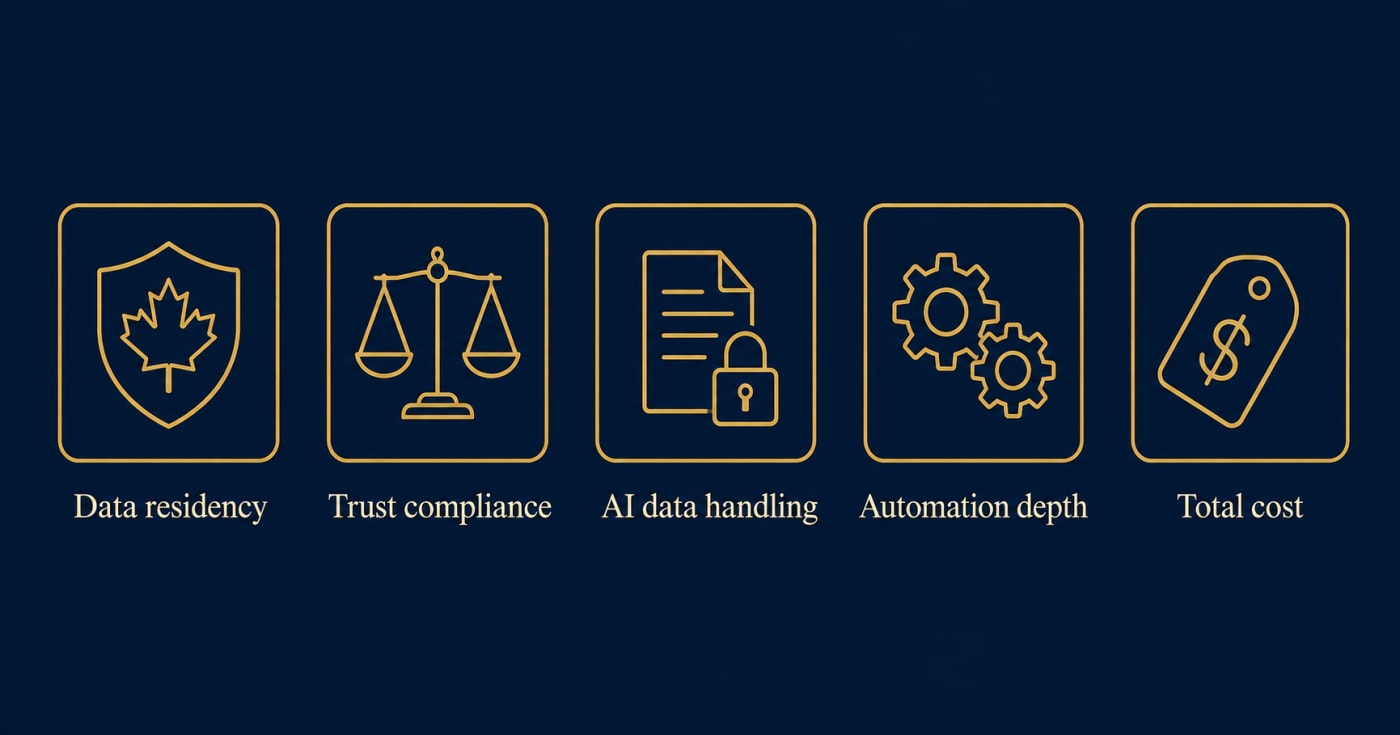
Before comparing feature lists, decide your criteria. For a Canadian firm in 2026, five matter most:
1. Data residency you can point to. Law societies across the provinces expect lawyers to protect confidentiality and to know where client data is stored. Data hosted in the United States can be subject to US legal process, which is why "where, exactly, are your servers?" should be your first vendor question — and the answer should be a named Canadian region, not a shrug.
2. Trust-accounting compliance as a design constraint, not a report. Ontario's trust rules (and their equivalents in other provinces) are unforgiving. Look for three-way reconciliation support and, more importantly, for what the software refuses to do: a system that can move trust money automatically is a system that can move trust money wrongly.
3. AI data handling you can explain to a client. The Law Society of Ontario's white paper on generative AI ties AI use to existing duties — competence (Rule 3.1-2), confidentiality (Rule 3.3-1), and supervision — and expects lawyers to understand how an AI system collects, stores, and uses data before client information goes into it.
This stopped being optional reading in practice: as of January 2026, Legal Aid Ontario roster lawyers must annually confirm on the Lawyer Self-Report that they have read and comply with the LSO's generative-AI guidance. Ask every vendor: is client data used to train models? How long is it retained? Where is it processed?
As of January 2026, Legal Aid Ontario roster lawyers must annually confirm on the Lawyer Self-Report that they have read and comply with the LSO's generative-AI guidance. Source: Legal Aid Ontario, Lawyer Self-Report requirement.
4. Automation depth. The 2026 divide is between software that records work and software that does work. If a platform's "automation" is workflow checklists, that is tracking. Real automation moves a matter forward on its own and stops for your approval at the decisions that matter.
5. Total cost in your currency. Add up base seats, AI add-ons, payments fees, and onboarding — in CAD. Ask any vendor whether pricing is flat and all-inclusive or stacks up with per-seat add-ons; the difference changes your real total fast.
The main Clio alternatives, honestly
CosmoLex — practice management with accounting built in, so trust bookkeeping does not require QuickBooks gymnastics. A strong fit if your bookkeeper is the main pain point; less focused on automating legal work itself.
PracticePanther — consistently the budget-friendly pick for solos and very small firms. Straightforward, but Canadian trust-compliance workflows will need more manual discipline.
Smokeball — document-heavy practices like it for its automatic time capture and deep document automation, with a Windows-desktop heritage. Verify Canadian hosting and CAD pricing for your setup before committing — for the fuller Canada-specific breakdown, see our dedicated Smokeball alternatives guide, and for Smokeball's 2026 agentic AI layer specifically, see our Smokeball AI alternative comparison.
Actionstep — workflow-oriented practice management aimed at midsize firms; substantial configurability, correspondingly substantial setup.
MyCase — a solid general-practice option for small firms; simple and quick to adopt, thinner on Canada-specific compliance depth.
Filevine — strongest in litigation and personal-injury project management; a US-centric platform, so apply the data-residency questions above with extra care.
Canadian context players: Dye & Durham tools are already embedded in many Ontario real-estate and corporate workflows (transaction data and filings rather than full practice management), and Alexi is Canadian AI legal research — a complement to a practice-management platform, not a replacement for one.
Where DROZlegal fits
DROZlegal is a Canadian practice-automation platform built in Ontario, and it takes a different starting point: instead of tracking work for you to do, it carries the work forward and stops at the decisions only a lawyer should make.
Concretely, and verifiably: all data is hosted in Canada (AWS Canada — ca-central-1, encrypted at rest and in transit).
When a prospective client submits an intake form, the system screens it, routes it, and produces a drafted engagement letter for the lawyer's approval — in live firm use this takes about two minutes from submission to a letter waiting at the approval gate.
The litigation module generates Ontario court forms as court-ready documents. Billing syncs two-way with QuickBooks Online.
Pricing is all-inclusive — every module is included at every tier, flat per firm (per user on the smallest Solo tier), with no per-module add-ons.
Compliance by design: trust accounting and AI data handling
On the two compliance criteria above, the design choices are deliberate.
Trust accounting is built around a permanent hard ceiling: the software can compute, reconcile, and flag, but movements of trust money can never be automated — that action is structurally reserved for a human, always.
On AI data handling: DROZlegal's AI runs on Anthropic's commercial API, which does not use client inputs or outputs for model training and deletes them automatically within approximately 30 days. That is a precise claim — it is not "zero retention," and any vendor who tells you their cloud AI has zero retention should be asked to put it in writing.
More on our security posture is on the security page.
The honest gaps
DROZlegal is currently onboarding a limited group of founding firms — if the automation-first approach fits how you want to run your practice, the waitlist is where that starts.
The honest gaps: it is a newer platform, there is no third-party app marketplace, and if your firm depends on a long tail of Clio integrations, that ecosystem is a real Clio advantage we do not match today.
When Clio is still the right choice
Choose Clio if you need the largest integration ecosystem in legal tech, established payment processing, or a platform your staff may already know from previous firms. For large firms with dedicated admin staff and heavily customized third-party stacks, the incumbent's maturity is worth real money.
The case for an alternative is strongest for small Canadian firms whose actual bottleneck is the work itself — intake, drafting, deadlines, trust bookkeeping — rather than the tracking of it.
Frequently asked questions
Does Clio store data in Canada? Clio offers Canadian data hosting. Whatever platform you choose, confirm the hosting region in writing and ask how AI features process data — the two answers can differ.
What should Ontario firms ask any AI-enabled vendor in 2026? Three questions, straight from the LSO's guidance framing: Is client data used to train models? How long is it retained and where? What stops the AI from acting without lawyer approval? A vendor who cannot answer all three crisply has answered you anyway.
Is switching practice-management platforms disruptive? Less than it was — most platforms import matters and contacts — but plan a transition window for trust-ledger reconciliation, and run both billing systems in parallel for one cycle. Ask each vendor what their onboarding actually includes before you sign.
Is Clio Duo still called Clio Duo? Updated August 2026: No — Clio rebranded it to Manage AI at ClioCon 2025 in Boston (October 2025), confirmed on Clio's own help center and ClioCon recap plus independent coverage. If you see "Clio Duo" in older articles, that's the same product under its current name. See our full Clio Duo / Manage AI comparison for what changed at the rebrand.
Not ready to subscribe? Join the DROZlegal waitlist instead.