
Disclosure: DROZlegal publishes this guide and builds the criminal-case tracking, Jordan s.11(b) clock, and disclosure workspace described below. This article is general information about Ontario criminal procedure, not legal advice, and does not create a solicitor-client relationship; it reflects Ontario and Canadian law, including a Supreme Court of Canada decision released this year, as of August 24, 2026.
What "AI criminal defence software" actually needs to track
Most of what search turns up for "criminal law practice management software" is a general case-management suite with a criminal-law tab bolted on — custom fields for charge type, a shared calendar, a document folder. Useful, but it skips the two things that actually define a criminal file: a hard constitutional deadline, and a Crown disclosure package that keeps growing after the file opens.
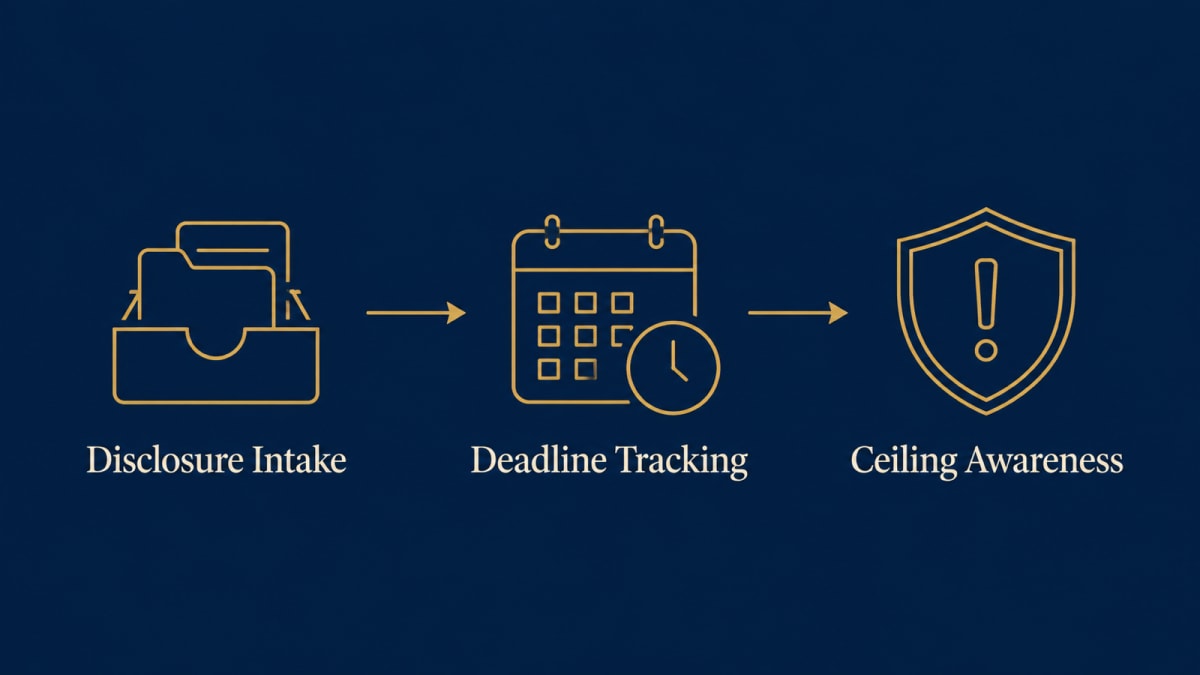
Real support for a criminal matter does three narrower jobs well. It tracks the charges and court appearances on the record. It computes the s.11(b) ceiling clock deterministically, the same way every time. And it organizes Crown disclosure by category as it lands, instead of leaving that to memory. None of that is legal judgment — all of it is information a lawyer would otherwise reconstruct by hand.
In fiscal 2022-23, 56% of Ontario criminal cases ended with charges withdrawn, stayed, dismissed, or discharged before a trial decision — a 14-percentage-point increase since 2013-14, with pandemic backlogs, resource shortages, and rising volumes of digital evidence all cited as contributing factors. Source: CBC News, reporting on Ontario court data, November–December 2024.
That's exactly why the tracking problem keeps getting harder: more digital disclosure per file, less room for the Jordan clock to run before a stay becomes the live risk.
The Jordan s.11(b) ceiling clock — a deadline it computes, not a decision it makes
Under R. v. Jordan, a criminal charge is presumed to have taken too long once net delay passes 18 months in provincial court or 30 months in superior court, measured from charge to the end of trial. The Supreme Court reaffirmed both ceilings on May 29, 2026, in a pair of companion decisions — R. v. Vrbanic, 2026 SCC 19, and R. v. Jacques-Taylor, 2026 SCC 20 — while also widening two of the paths the Crown can use to justify delay beyond the ceiling: case complexity, and delay caused by co-accused scheduling conflicts.
The ceiling number didn't move. What counts as an exceptional circumstance around it did. Source: Supreme Court of Canada, R. v. Vrbanic and R. v. Jacques-Taylor (May 29, 2026); case commentary via McCarthy Tétrault and Rudnicki & Company.
That's precisely the kind of moving target a deterministic clock is built for, and precisely where its job ends. Per DROZlegal's own capability inventory, the criminal module computes the Jordan ceiling through a dedicated API route, with a branch for matters that went through a preliminary inquiry (the math changes), and surfaces the running clock on the case file. It does the arithmetic. It does not weigh whether a given stretch of delay counts as a Vrbanic-style complexity exception or a Jacques-Taylor-style discrete circumstance — that judgment call, like every judgment call on the file, stays with the lawyer.

The disclosure workspace — sorting volume, not judging relevance
Disclosure is where a criminal file's real volume problem shows up — body-camera footage, text extracts, witness statements, and expert reports arriving in waves, often unlabelled. DROZlegal's disclosure workspace, built into the case file, lets a lawyer track completeness and override the category on each item as it comes in.
Behind it sits a manually dispatched classification agent, not an autonomous one. The disclosure_review agent — one of DROZlegal's 22 registered agent classes — sorts incoming material into the Stinchcombe, McNeil, and O'Connor disclosure categories, the taxonomy Canadian criminal disclosure law runs on. It only runs when a lawyer dispatches it, and it only proposes a classification, never acts on one. It also enforces case isolation by design: every job is scoped to exactly one matter, and a mismatched case ID is refused before it ever reaches the underlying AI model, not caught after the fact. For the full classification taxonomy — including a 2026 SCC case that just moved the McNeil/O'Connor line — see our deep dive on AI disclosure review software for Ontario criminal defence.
Charges, informations, and court appearances — what the API actually tracks
Underneath the clock and disclosure workspace sits the case record itself. The criminal module, shipped August 19, 2026, includes dedicated models for informations and charges, a 15-route API, and bail s.503/OCJ appearance-deadline rules in the same deterministic engine that runs the Jordan clock — rule-based date math, no AI call involved.
| What's tracked | How it works | Human role |
|---|---|---|
| Informations & charges | Dedicated case models record the information, each charge, and the matter's procedural history | Lawyer enters and reviews the record |
| Jordan s.11(b) ceiling | Deterministic computation against the 18-month provincial / 30-month superior-court ceilings, with a preliminary-inquiry branch | Lawyer decides what a given stretch of delay means for the file |
| Court appearances & bail s.503 deadlines | Rule-based deadline engine tracks OCJ appearance and bail-hearing timing | Lawyer appears, argues, and decides the bail position |
| Crown disclosure | Category tracking and a completeness view over disclosure items as they arrive | Lawyer reviews and confirms completeness |
| Disclosure classification | disclosure_review agent proposes Stinchcombe/McNeil/O'Connor categorization — manually dispatched, case-isolated | Lawyer reviews and accepts or corrects the proposal |
Source: DROZlegal's own capability inventory (criminal module, shipped August 19, 2026).
What it doesn't do — the hard-ceiling discipline applied to a criminal file
None of the above files anything, appears in court, or decides anything on a lawyer's behalf. DROZlegal applies the same permanent hard ceilings across every practice area it supports — trust money movement, court filing, settlement, commencing litigation, engagement approval, and agent-initiated external communication — and none of them are automatable, full stop. On a criminal file specifically: nothing in the module files a document with the Ontario Court of Justice, requests or opposes bail, enters a plea, or negotiates with the Crown. The Jordan clock reports a number; the disclosure_review agent proposes a category. A lawyer reads both and decides what they mean — every time, no exceptions.
Worth saying plainly: this module shipped and went live August 19, 2026, but as of this writing no design partner has run a live matter through it. Everything above describes what it does, not what a firm has reported back.
Update, September 5, 2026. In February 2026, the Ontario Superior Court of Justice extended its AI practice directions to criminal proceedings specifically, alongside the civil and family versions already in place. The criminal-proceedings direction (Section I of the Consolidated Provincial Practice Direction for Criminal Proceedings, ontariocourts.ca) doesn't touch the Jordan clock, bail, or disclosure classification described above — it imposes the same citation-verification duty as the civil and family directions, delivered through Rules 32 (books of authority) and 33 (factums) of the Criminal Proceedings Rules: every AI-touched authority hyperlinked, pinpointed, and checked against an authoritative source before it's filed, backstopped by the same range of court sanctions (reprimand, costs, adjournment, contempt, a Law Society referral). It's a citation-integrity rule wired into existing criminal filing practice, not a new procedural track for AI in criminal court. See our tracker of every Ontario court AI disclosure rule, including the criminal-specific one, for the full set.
Update, September 21, 2026. Worth being precise about which court that citation-verification duty actually reaches: almost every criminal matter this module supports — bail, disclosure, trial — commences in the Ontario Court of Justice (OCJ), not the Superior Court whose practice direction is described above. Checked directly against the OCJ's own site, its criminal practice-directions library and Criminal Rules carry no AI-specific provision of their own. The Law Society of Ontario's conduct rules, not a court-specific AI direction, are what actually binds a lawyer's AI use on a typical OCJ file. See our full breakdown of what does and doesn't reach the Ontario Court of Justice for the distinction.
Update, September 21, 2026. This module's tracking layer is now one piece of a wider evaluation. For the full buyer's guide to criminal defence practice management software in Ontario — billing on legal-aid tariffs alongside private retainers, hard-ceiling governance, and an 8-platform comparison — see our new cornerstone guide: Criminal Defence Practice Management Software in Ontario: The Complete 2026 Guide.
What to check before you adopt AI criminal defence software
Criminal-defence AI adoption is still early industry-wide. Nearly two-thirds of criminal law professionals report using general-purpose AI tools personally, but only 29% of criminal-defence firms have formally adopted legal-specific AI, and 87% cite a lack of trust in AI-generated output as a limiting factor. Source: 8am, 2026 Legal Industry Report.
Whatever platform your firm evaluates — DROZlegal or otherwise — these questions separate real tracking support from a feature list:
- Does it compute the Jordan ceiling deterministically, or estimate it? A ceiling clock built on fixed date math against the 18/30-month rule is checkable; one built on a model's guess is not.
- Does it isolate disclosure by case, or risk cross-file exposure? Wagg/Juman-style per-case isolation — refusing a mismatched case ID before it reaches any AI model — should be a design choice you can point to, not a promise.
- Does anything file, plead, or argue bail without you? It shouldn't, and nothing in the module does. Court filing is a permanent hard ceiling; a bail or plea position is a legal judgment call the platform was never built to make at all.
- Where does the data live, and under what retention terms? Stored client data staying in Canada (DROZlegal: AWS ca-central-1) and AI processing that doesn't train on client data and auto-deletes within roughly 30 days is a specific, checkable claim — see DROZlegal's security architecture for the full posture. "Zero retention" isn't a real category; press any vendor claiming it for the actual terms.
The criminal module is one piece of a wider practice-automation platform — see the product overview for how case tracking and the daily briefing fit together, or the AI Agents page for how the agent roster and job queue work. New to how AI fits into a law practice generally? Start with the Lawyer AI Academy guide.
Not ready to subscribe? Join the DROZlegal waitlist instead.